
Article
Universal Article


How AI Concierge Tools Are Changing Hospitality Service Delivery
This article looks at the practical, current state of AI in hospitality service delivery, with a clear focus on what supports hotel teams rather than what replaces them.
Artificial intelligence has moved from a hospitality buzzword to a genuinely useful layer within guest service technology, though not always in the dramatic ways the headlines suggest. AI concierge tools are not replacing hotel staff with robots at the front desk. In most cases, they are working quietly in the background, helping route requests faster, answering common guest questions instantly, and giving staff better information to act on. For general managers and IT managers evaluating hospitality technology, it is worth understanding what AI concierge tools actually do today, rather than the more speculative version often discussed in industry trend pieces.
Short Answer: What Do AI Concierge Tools Do in Hotels?
AI concierge tools in hotels typically handle routine guest questions and requests automatically, such as answering common queries about hotel facilities, hours, or services, and help route guest requests to the correct team faster and more accurately. They work alongside human staff, handling repetitive, predictable interactions so that staff have more time for requests that need judgement, empathy, or local knowledge. AI is not generally used to replace concierge or front office teams, but to reduce the volume of routine queries they handle directly.
Where AI Is Genuinely Useful in Hospitality Today
Answering Common Guest Questions Instantly
Many guest questions are highly predictable, what time is breakfast, is the gym open, how do I get to the airport. AI-powered chat tools can answer these instantly, at any hour, without requiring a staff member to respond.
Smarter Request Routing
AI can help categorise and prioritise incoming requests, ensuring a housekeeping request reaches housekeeping and a maintenance issue reaches the right team, without manual sorting.
Multi-Language Support
AI translation capabilities allow guest-facing menus and chat tools to support multiple languages more easily, helping international guests communicate requests clearly without needing bilingual staff on every shift.
Pattern Recognition in Guest Data
AI can help identify patterns in guest requests and feedback that might be difficult for staff to spot manually, such as recurring complaints about a specific service or time of day.
Where AI Should Support, Not Replace, Staff
It is important to be direct about this distinction. Guest interactions that involve complaint resolution, personal recommendations, or anything requiring genuine empathy and judgement remain firmly in the domain of trained hospitality staff. AI concierge tools work best when they handle the predictable, repetitive layer of guest interaction, freeing staff to focus on the moments that benefit most from a human touch.
Industry Context: Why This Is Gaining Momentum Now
Guest expectations have shifted significantly. Many travellers are accustomed to instant, 24-hour responses from AI-powered tools in other parts of their lives, from customer service chatbots to travel booking assistants. Hotels that cannot offer at least a basic level of instant response risk feeling slow by comparison, even if their human service quality is excellent.
Practical Implementation Tips
- Start with FAQ-style automation. Common, predictable questions are the safest and most effective starting point for AI concierge tools.
- Keep a clear handoff to human staff. Guests should always be able to escalate to a person easily if an AI tool cannot resolve their query.
- Monitor AI responses regularly. Review what guests are asking and how the tool is responding, adjusting as needed.
- Be transparent with guests. Most guests are comfortable interacting with AI tools when it is clear that's what they're using, and when a human option remains available.
Mistakes to Avoid
- Deploying AI tools without a clear escalation path to staff for complex requests.
- Using AI for guest interactions that require empathy or judgement, where a generic response can feel dismissive.
- Failing to review and refine AI responses over time, leading to outdated or inaccurate information.
- Overstating AI capabilities to guests or staff, creating unrealistic expectations.
Example Scenario
A mid-sized hotel introduced an AI-powered chat assistant within its digital concierge platform to handle common guest questions about facilities, hours, and basic service availability. The assistant resolved a significant share of routine queries instantly, including outside staffed hours, while clearly offering guests the option to reach a staff member for anything more complex. Front desk staff reported fewer interruptions for simple questions, with more time available for guests needing direct assistance.
How This Connects to Broader Digital Concierge Strategy
AI concierge tools work best as one layer within a broader digital concierge platform, alongside QR ordering, housekeeping request management, and staff notification systems. The goal across all of these is the same: handle predictable, repetitive interactions efficiently, so that hotel teams can focus their attention where it matters most.
Frequently Asked Questions
Will AI concierge tools replace hotel staff? No. AI concierge tools are designed to handle routine, predictable interactions, allowing staff to focus on guest needs that require judgement and personal attention.
What kinds of questions can AI concierge tools answer? Common examples include facility hours, service availability, basic local recommendations, and general property information.
Can AI tools handle guest complaints? AI tools can capture and route complaints to the right team, but resolution generally still requires human staff involvement, particularly for sensitive issues.
Do AI concierge tools work in multiple languages? Many AI-powered tools support multi-language interaction, which can be particularly useful for hotels with a diverse international guest base.
Is AI concierge technology only suitable for large hotels? No. Smaller hotels can benefit significantly, particularly for handling after-hours queries when staff coverage is limited.
How do guests know they are speaking with an AI tool rather than a person? Most well-implemented platforms are transparent about this, and offer a clear, easy way to reach a human staff member if needed.
How accurate are AI concierge responses? Accuracy depends on how well the tool is set up and maintained. Regular review of common queries and responses helps keep information current and relevant.
How Superbutler Solves This
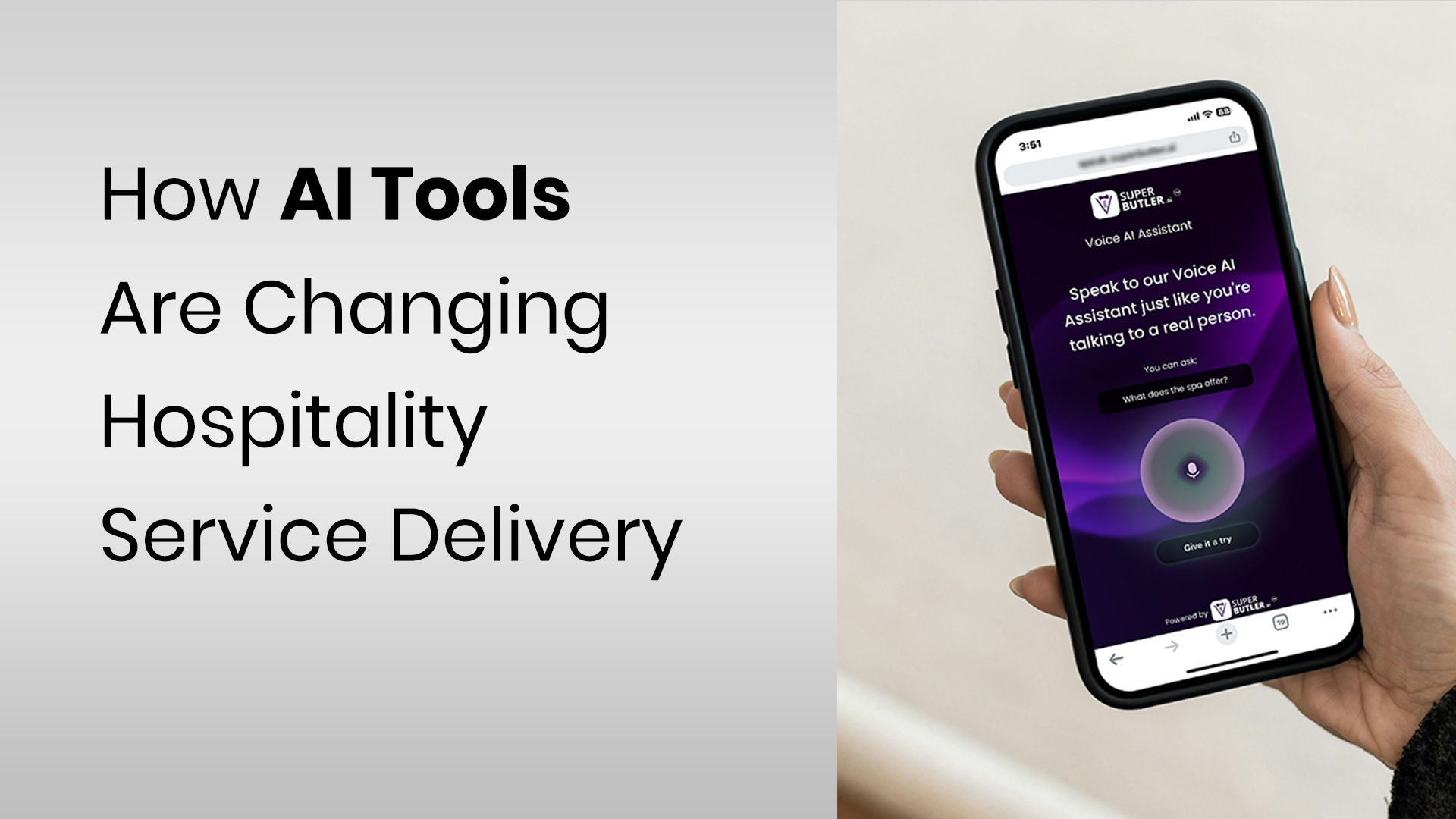
Superbutler.ai is itself an AI-powered, multilingual digital concierge platform, built around exactly this support-not-replace principle. Its AI Chat Assistant answers common guest questions and routes requests to the right team instantly in the guest's own language, while its Voice AI Assistant lets guests simply speak a request rather than type one, both designed to streamline hotel operations without removing staff from fulfilment or personal interaction. For hotels, the practical pillars are clear: lower operational cost from fewer repetitive queries reaching staff directly, increased ancillary revenue from better service visibility, and improved guest reviews driven by faster, round-the-clock responsiveness.
Conclusion
AI concierge tools are changing hospitality service delivery in practical, incremental ways, answering routine questions instantly, helping route requests accurately, and supporting multi-language guest interaction. The technology works best as a support layer for hotel staff, not a replacement, handling the repetitive groundwork so teams can focus on the guest interactions that benefit most from a human presence.
To explore how AI-supported guest service could work alongside your team, book a free 20-minute consultation with Superbutler.